About the practitioner
A private practice, made public.
Exponential Quality is the public-facing arm of a private investment practice based in Singapore. The portfolio is a multi-generational family mandate, structured loosely on the Buffett Partnership model, with no external redemption pressure and a horizon measured in decades rather than quarters.
The work here is straightforward: I publish my analysis on the businesses I study, the decisions I make, and the framework I use to make them. The goal is not to give advice. The goal is to think clearly in public, and to find readers who want to do the same.
The framework
The investment philosophy is Charlie Munger's Quality School of Value Investing which is called Buying Wonderful Companies at Fair Prices — WCAFP for short. Roughly 88% of the family's portfolio sits inside this framework. The remainder is allocated to deep value situations where the margin of safety comes from the price rather than the business.
WCAFP is sometimes confused with Growth-At-A-Reasonable-Price / GARP Investing. The distinction matters. Two principles separate them:
Graham's first commandment
A fair price under WCAFP still requires a discount to conservatively assessed intrinsic value. GARP often pays for growth at fair value. WCAFP demands a buffer.
Asymmetric assessment
Intrinsic value is calculated under conservative assumptions with explicit downside protection. The asymmetry must favour the holder before any position is sized.
Research Analyst Background
My name is Shawn and my background is versatile, having completed studies in Systems Engineering at the diploma level, Sociology at the undergraduate level and Finance & Business Analytics at the post-graduate level. This variety of viewpoints and differing frameworks allows me to develop robust mental models (as was pioneered by the late Billionaire Investor Charlie Munger) used in investing, and as stated in the book Investing: The Last Liberal Art by Robert G. Hagstrom. I have read hundreds of investing, finance, economics and business books, and know what often works in investing and what doesn't work well. Join me on my investing journey as we all seek to have more than enough liquid assets for emergencies and a comfortable long-term retirement.
The inspiration: Mr. Womack's truckload of pigs
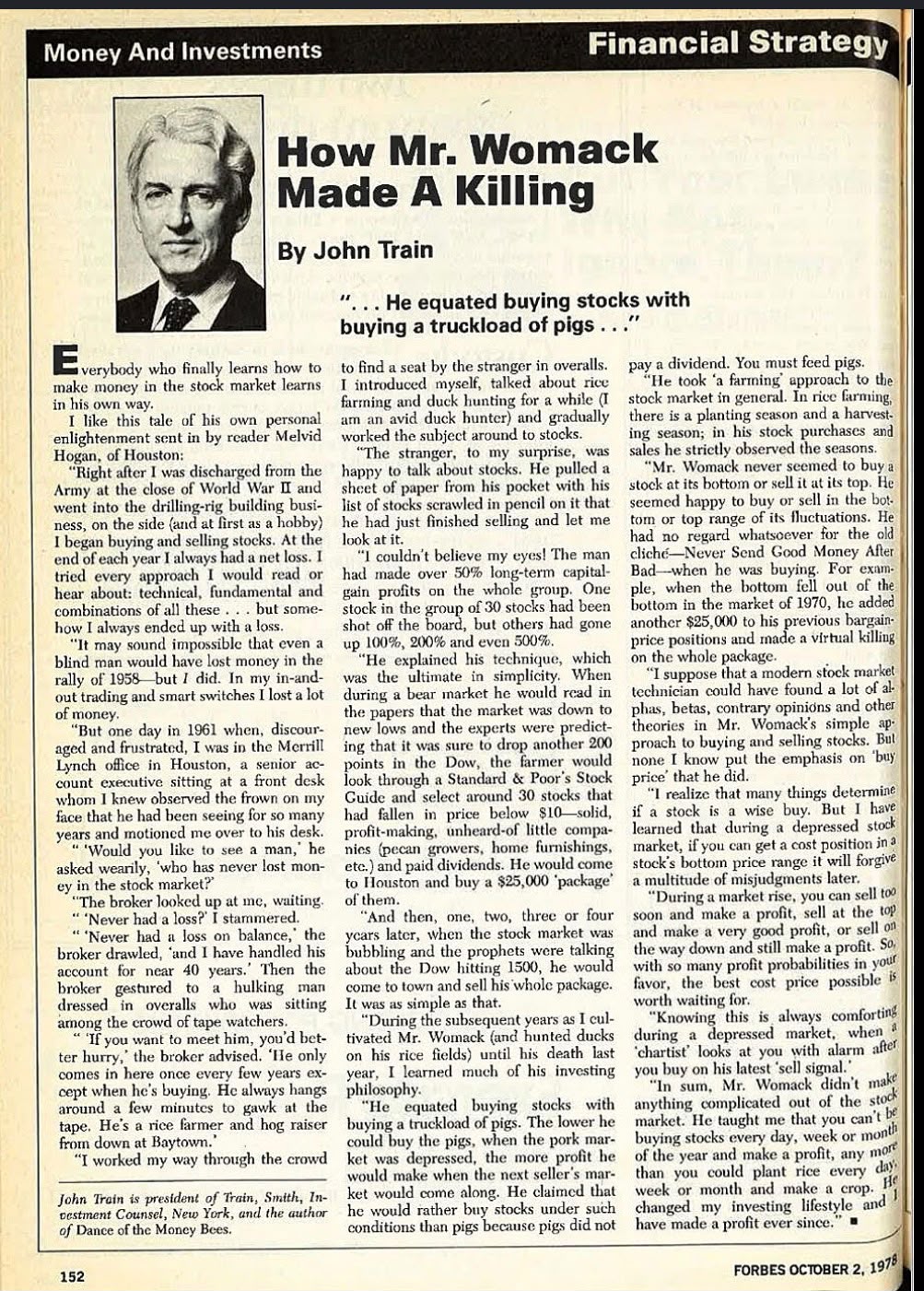
Every so often you come across a story that reframes what you believe is possible. For me, that story is about a man the financial press simply called Mr. Womack — a rice farmer and hog raiser from Baytown, Texas, with no described background in finance, who quietly became one of the most successful stock market investors his own broker had ever handled.
The story was told to Forbes columnist John Train by a reader, Melvid Hogan of Houston, who first encountered it in a Merrill Lynch office in 1961. Hogan had spent years losing money trading stocks — by his own account, he had “lost money in the rally of 1958” through constant in-and-out trading and clever switches between positions. One day, a senior account executive who had watched him lose money for years finally asked him a question that stopped him cold: would he like to meet a man who had never lost money in the stock market — not once, in the near 40 years the broker had personally handled his account?
That man was Mr. Womack, sitting quietly in the corner of the office in overalls, gawking at the ticker tape. He came into town, the broker explained, only once every few years — and only when he was buying.
Womack's method was almost embarrassingly simple. During a bear market — when the newspapers were full of experts predicting the Dow had further to fall — he would work through a Standard & Poor's Stock Guide and select around 30 stocks that had fallen below $10 a share: solid, profit-making, largely unheard-of small companies — pecan growers, home-furnishings makers, and the like — that still paid a dividend. He would come to Houston, buy a roughly $25,000 package of them, then go home to his rice fields and his ducks. Years later, once the market was bubbling and the talk had turned to the Dow hitting 1,500, he would come back and sell the whole package.
The results were remarkable. On one such package of 30 stocks, Womack made more than 50% long-term capital-gains profit — even though one of the thirty had been delisted entirely along the way. The others had risen 100%, 200%, and in at least one case, 500%. When the market bottom fell out again in 1970, he simply added another $25,000 to his existing bargain-priced positions and made, in his broker's words, “a virtual killing” on the whole package.
“He equated buying stocks with buying a truckload of pigs.”
The logic, as his broker explained it: the lower the price at which you can buy during a depressed market, the more profit you stand to make once conditions eventually turn. Womack reasoned that stocks were actually the better bargain of the two, because unlike a pig, a cheaply bought stock does not need to be fed while you wait for the next seller's market — and, if you choose well, it pays you a dividend in the meantime.
He ran his stock portfolio the way he ran his farm: there was a planting season and a harvesting season, and he strictly observed the equivalent seasons in his buying and selling. He never bought exactly at the bottom or sold exactly at the top, and he had no interest in the old maxim about never sending good money after bad — when prices fell further after he had already bought, he simply bought more.
What struck me most, reading this story, is not that Mr. Womack was clever. By his own broker's account, he ignored technical analysis, betas, contrarian indicators, and every other theory a modern analyst might reach for. His entire edge was one idea, applied with total discipline: get your cost basis low enough, in a business that is solid and pays you to wait, and a good buy price will forgive a great many misjudgments later. As he saw it, a sufficiently attractive entry price meant that almost every exit — selling too early, selling right at the top, or even selling on the way back down — could still turn a profit.
Stories like Mr. Womack's are a large part of why Exponential Quality exists. A man with no formal training in finance, working a family rice farm and raising hogs in rural Texas, built extraordinary long-term investment returns simply by being patient, disciplined, and willing to buy good businesses cheaply when nobody else wanted them. That kind of outcome — an ordinary person, with no institutional advantage, using the public equity markets to compound wealth over decades — is remarkably difficult to replicate under almost any other historical economic system. Capitalism, and specifically the public equity markets it makes possible, offers an individual investor a genuine and repeatable path toward financial independence that has not been available for most of human history, and still is not available across much of the world today.
I am not claiming Mr. Womack's exact results, and I did not grow up on a rice farm. But his story, and others like it, is a large part of why I built the framework behind this site the way I did, and why I chose to start publishing it. I have applied the same underlying discipline that Mr. Womack demonstrated — patience, a relentless focus on the price paid relative to what a business is actually worth, and a willingness to buy quality when it is unloved — to my own family's portfolio, with the track record set out below. My hope is that readers and clients of Exponential Quality can use the same discipline to work toward their own comfortable, well-funded retirement, the way I have worked to build one for my own family.
The track record
Over the five years from 17 August 2021 to 17 August 2026, the US equity sleeve has compounded at 30.41% CAGR against CSPX's 12.49%, generating approximately 1,792 basis points of annualised alpha. The overall family portfolio, which includes other geographies and asset categories, has compounded at 18.75% CAGR against VT's 10.43%, generating approximately 832 basis points of annualised alpha.
Returns are money-weighted nominal CAGR (IRR), calculated by Sharesight Portfolio Analytics Tracker Platform from custodian-linked transaction records over the identical five-year window for both portfolios and benchmarks, and reflect all the buy and sell orders and the full transaction history of each portfolio, measuring the performance of all positions held from 17 August 2021 until 17 August 2026. The MWR vs TWR distinction matters and is disclosed in detail on the homepage; in short, MWR reflects what the family's actual wealth compounded at, including the timing of capital additions, rather than the institutional-standard TWR which isolates investment-decision quality from cash-flow timing.
Five years is too short a window to claim skill. Fama-French and Andrew Lo are both explicit about this. What it does establish is a process — and a process is the only thing a long-horizon investor can actually own.
Performance attribution remains an open project. The next iteration of this practice involves formal factor decomposition to separate style exposure from genuine alpha. That work is in progress and will be published when complete.
The structural advantage
The single most important feature of this practice is not the framework or the track record. It is the mandate. A multi-generational family pool with no redemption pressure and a 30-year horizon does not need to outperform every quarter, or every year, or even every five years. It needs to compound — patiently, with conviction, through whatever the world throws at it.
That structural advantage is what allowed counter-cyclical capital deployment during the April 2025 drawdown, and it is what allows the patience required to hold genuinely wonderful businesses through their inevitable bad years.
What this site is — and isn't
This site is a place to read, learn, and think alongside a working practitioner. It is not a substitute for personalised financial advice, and nothing published here should be construed as such. I am not a licensed financial adviser. The writing is general commentary on publicly listed securities, intended for educated retail investors who want to develop their own conviction.
If you find the writing useful, the Sunday Letter is free. If you want to go deeper, The Quality Library teaches the framework in detail. If you want to follow the live portfolio work, Premium Research is the membership tier.
Either way — welcome. Read patiently. Think slowly. Own quality.